Neil Armstrong Tribute Page
One small step for man, one giant leap for mankind

X-15-1 research flight in 1960, A black-and-white photo of Armstrong, with very short hair. He is smiling and is wearing a pressure suit and tall lace-up boots. Under his left arm he holds a bulky pressure helmet. He has black gloves on, and his right-hand rests on the nose of a dark-painted X-15 rocket plane with its canopy open. Armstrong and the plane are standing on a desert crust, and the plane's skids have left tracks in it.
By NASA - Great Images in NASA,sorced from wikipedia, Public Domain, Link

The Man..
Neil Alden Armstrong (August 5, 1930 - August 25, 2012) was an American astronaut and aeronautical engineer who was the first person to walk on the Moon. He was also a naval aviator, test pilot, and university professor. 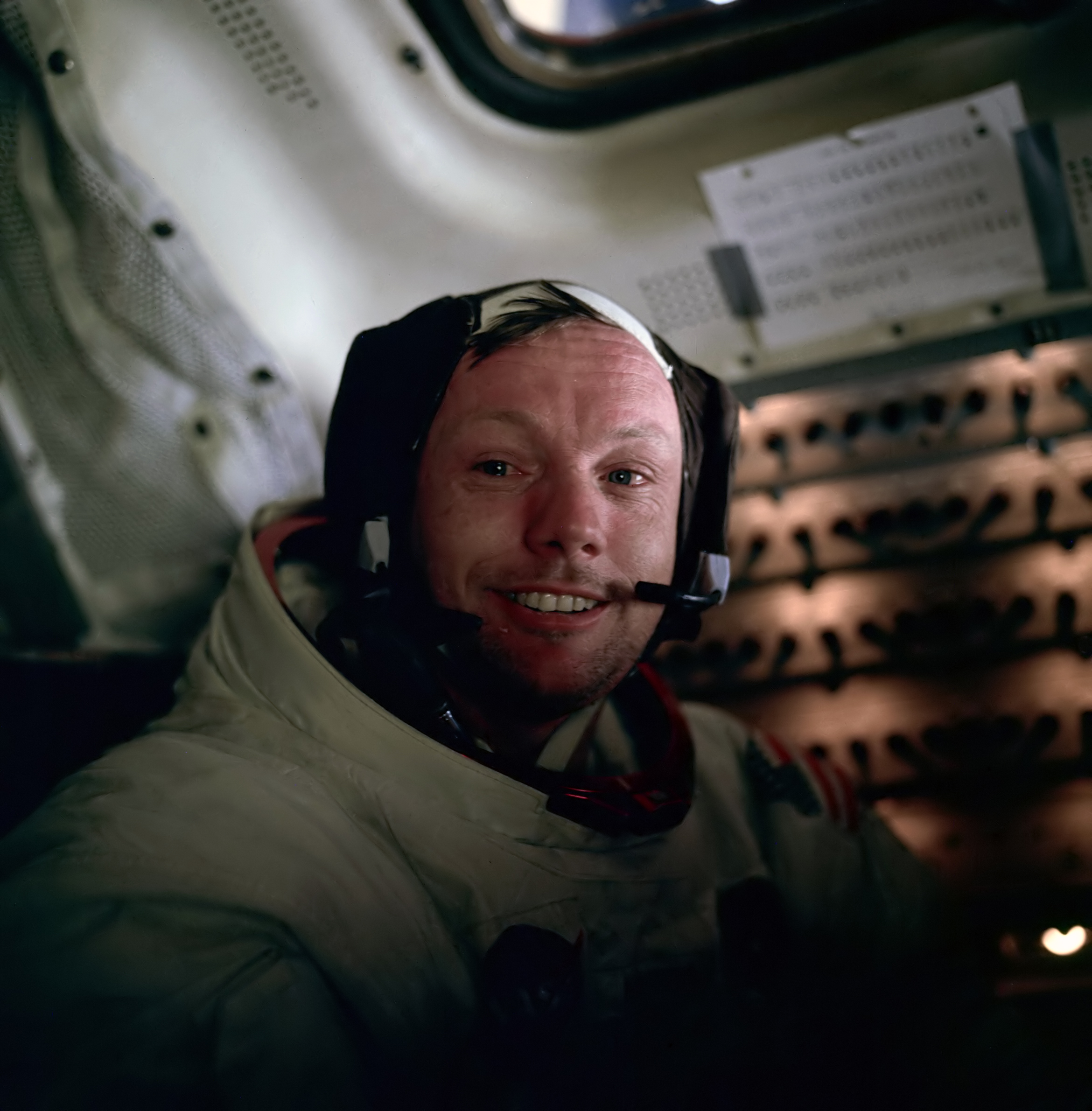
A graduate of Purdue University, Armstrong studied aeronautical engineering; his college tuition was paid for by the U.S. Navy under the Holloway Plan. He became a midshipman in 1949 and a naval aviator the following year. He saw action in the Korean War, flying the Grumman F9F Panther from the aircraft carrier USS Essex. In September 1951, while making a low bombing run, Armstrong's aircraft was damaged when it collided with an anti-aircraft cable which cut off a large portion of one wing. Armstrong was forced to bail out. After the war, he completed his bachelor's degree at Purdue and became a test pilot at the National Advisory Committee for Aeronautics (NACA) High-Speed Flight Station at Edwards Air Force Base in California. He was the project pilot on Century Series fighters and flew the North American X-15 seven times. He was also a participant in the U.S. Air Force's Man in Space Soonest and X-20 Dyna-Soar human spaceflight programs.

Armstrong joined the NASA Astronaut Corps in the second group, which was selected in 1962. He made his first spaceflight as command pilot of Gemini 8 in March 1966, becoming NASA's first civilian astronaut to fly in space. During this mission with pilot David Scott, he performed the first docking of two spacecraft; the mission was aborted after Armstrong used some of his re-entry control fuel to stabilize a dangerous roll caused by a stuck thruster. During training for Armstrong's second and last spaceflight as commander of Apollo 11, he had to eject from the Lunar Landing Research Vehicle moments before a crash.
On July 20, 1969, Armstrong and Apollo 11 Lunar Module (LM) pilot Buzz Aldrin became the first people to land on the Moon, and the next day they spent two and a half hours outside the spacecraft while Michael Collins remained in lunar orbit in the mission's command module (CM). When Armstrong stepped onto the lunar surface, he famously said: "That's one small step for [a] man, one giant leap for mankind." Along with Collins and Aldrin, Armstrong was awarded the Presidential Medal of Freedom by President Richard Nixon. President Jimmy Carter presented Armstrong with the Congressional Space Medal of Honor in 1978, and Armstrong and his former crewmates received a Congressional Gold Medal in 2009.
After he resigned from NASA in 1971, Armstrong taught in the Department of Aerospace Engineering at the University of Cincinnati until 1979. He served on the Apollo 13 accident investigation and on the Rogers Commission, which investigated the Space Shuttle Challenger disaster. He acted as a spokesman for several businesses and appeared in advertising for the automotive brand Chrysler starting in January 1979.
Early years
Armstrong was born on August 5, 1930, near Wapakoneta, Ohio to Stephen Koenig Armstrong and Viola Louise née Engel. He was of German, Scottish, and Scots-Irish ancestry, and had a younger sister, June, and a younger brother, Dean. His father worked as an auditor for the Ohio state government, and the family moved around the state repeatedly, living in sixteen towns over the next fourteen years. Armstrong's love for flying grew during this time, having started early when his father took his two-year-old son to the Cleveland Air Races. When he was five or six, he experienced his first airplane flight in Warren, Ohio when he and his father took a ride in a Ford Trimotor, also known as the "Tin Goose".
His father's last move was in 1944, back to Wapakoneta. Armstrong attended Blume High School and took flying lessons at the grassy Wapakoneta airfield. He earned a student flight certificate on his sixteenth birthday, then soloed in August, all before he had a driver license. He was active in the Boy Scouts and earned the rank of Eagle Scout. As an adult, he was recognized by the Boy Scouts of America with its Distinguished Eagle Scout Award and Silver Buffalo Award. On July 18, 1969, while flying toward the Moon, Armstrong greeted the Scouts holding their quadrennial National Jamboree in Idaho. Among the few personal items that he carried with him to the Moon and back was a World Scout Badge.
At age 17 in 1947, Armstrong began studying aeronautical engineering at Purdue University. He was the second person in his family to attend college. He was also accepted to the Massachusetts Institute of Technology (MIT), but after watching a football game between the Purdue Boilermakers and the Ohio State Buckeyes at the Ohio stadium in 1945, in which the Boilermakers, led by quarterback Bob DeMoss, soundly defeated the highly regarded Buckeyes, he resolved to go to Purdue. An uncle who had attended MIT advised him that it was not necessary to go all the way to Cambridge, Massachusetts, for a good education. His college tuition was paid for under the Holloway Plan. Successful applicants committed to two years of study, followed by two years of flight training and one year of service in the U.S. Navy as an aviator, then completion of the final two years of their bachelor's degree. Armstrong did not take courses in naval science, nor did he join the Naval Reserve Officers Training Corps
Career
Armstrong call up from the Navy was on January 26, 1949
On August 29, 1951, Armstrong saw action in the Korean War as an escort for a photo reconnaissance plane over Songjin.
In all, Armstrong flew 78 missions over Korea for a total of 121 hours in the air, a third of them in January 1952, with the final mission on March 5, 1952. Of 492 U.S. Navy personnel killed in the Korean War, 27 of them were from Essex on this war cruise. Armstrong received the Air Medal for 20 combat missions, two gold stars for the next 40, the Korean Service Medal and Engagement Star, the National Defense Service Medal, and the United Nations Korea Medal.
 Following his graduation from Purdue, Armstrong became an experimental research test pilot. He applied at the National Advisory Committee for Aeronautics (NACA) High-Speed Flight Station at Edwards Air Force Base. NACA had no open positions, and forwarded his application to the Lewis Flight Propulsion Laboratory in Cleveland, where Armstrong made his first test flight on March 1, 1955. Armstrong's stint at Cleveland lasted only a couple of months before a position at the High-Speed Flight Station became available, and he reported for work there on July 11, 1955.
 In June 1958, Armstrong was selected for the U.S. Air Force's Man In Space Soonest program, but the Advanced Research Projects Agency (ARPA) canceled its funding on August 1, 1958, and on November 5, 1958, it was superseded by Project Mercury, a civilian project run by NASA. As a NASA civilian test pilot, Armstrong was ineligible to become one of its astronauts at this time, as selection was restricted to military test pilots.[53][54] In November 1960, he was chosen as part of the pilot consultant group for the X-20 Dyna-Soar, a military space plane under development by Boeing for the U.S. Air Force, and on March 15, 1962, he was selected by the U.S. Air Force as one of seven pilot-engineers who would fly the X-20 when it got off the design board
After Armstrong served as backup commander for Apollo 8, Slayton offered him the post of commander of Apollo 11 on December 23, 1968, as Apollo 8 orbited the Moon. According to Armstrong's 2005 biography, Slayton told him that although the planned crew was Commander Armstrong, Lunar Module Pilot Buzz Aldrin, and Command Module Pilot Michael Collins, he was offering Armstrong the chance to replace Aldrin with Jim Lovell. After thinking it over for a day, Armstrong told Slayton he would stick with Aldrin, as he had no difficulty working with him and thought Lovell deserved his own command. Replacing Aldrin with Lovell would have made Lovell the lunar module pilot, unofficially the lowest ranked member, and Armstrong could not justify placing Lovell, the commander of Gemini 12, in the number 3 position of the crew. The crew of Apollo 11 was officially announced on January 9, 1969, as Armstrong, Collins, and Aldrin, with Lovell, Anders, and Fred Haise as the backup crew.
 According to Chris Kraft, a March 1969 meeting among Slayton, George Low, Bob Gilruth, and Kraft determined that Armstrong would be the first person on the Moon, in part because NASA management saw him as a person who did not have a large ego. A press conference on April 14, 1969, gave the design of the LM cabin as the reason for Armstrong's being first; the hatch opened inwards and to the right, making it difficult for the LM pilot, on the right-hand side, to exit first. At the time of their meeting, the four men did not know about the hatch consideration. The first knowledge of the meeting outside the small group came when Kraft wrote his book. Methods of circumventing this difficulty existed, but it is not known if these were considered at the time. Slayton added, "Secondly, just on a pure protocol basis, I figured the commander ought to be the first guy out ... I changed it as soon as I found they had the time line that showed that. Bob Gilruth approved my decision.
Apollo 11's objective was to land safely on the Moon, rather than to touch down at a precise location. Three minutes into the lunar descent, Armstrong noted that craters were passing about two seconds too early, which meant the LM Eagle would probably touch down several miles (kilometres) beyond the planned landing zone. As the Eagle's landing radar acquired the surface, several computer error alarms sounded. The first was a code 1202 alarm, and even with their extensive training, neither Armstrong nor Aldrin knew what this code meant. They promptly received word from CAPCOM Charles Duke in Houston that the alarms were not a concern; the 1202 and 1201 alarms were caused by executive overflows in the lunar module computer. In 2007, Aldrin said the overflows were caused by his own counter-checklist choice of leaving the docking radar on during the landing process, causing the computer to process unnecessary radar data. When it did not have enough time to execute all tasks, the computer dropped the lower-priority ones, triggering the alarms. Aldrin said he decided to leave the radar on in case an abort was necessary when re-docking with the Apollo command module; he did not realize it would cause the processing overflows.
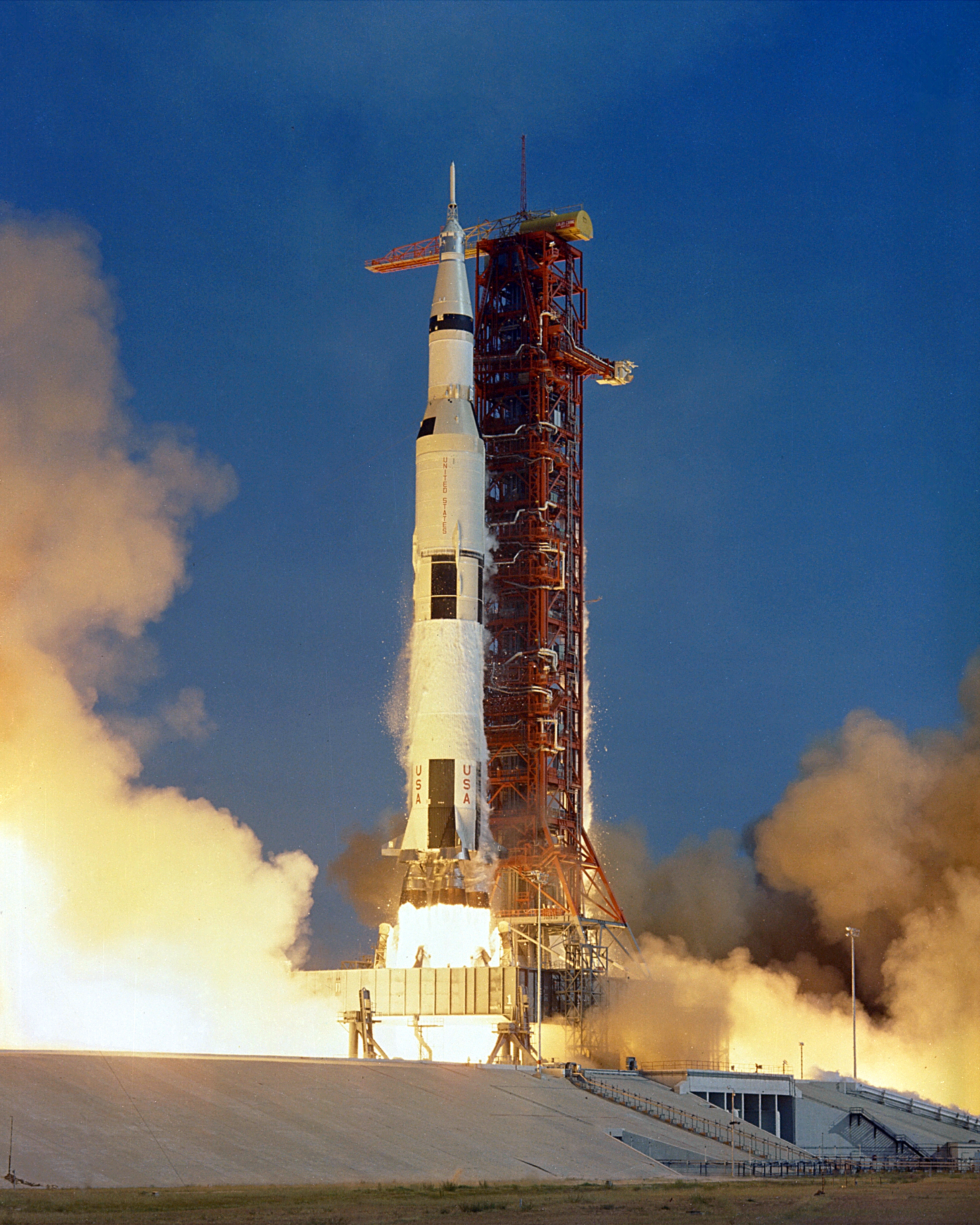 The landing on the surface of the Moon occurred several seconds after 20:17:40 UTC on July 20, 1969. One of three 67-inch (170 cm) probes attached to three of the LM's four legs made contact with the surface, a panel light in the LM illuminated, and Aldrin called out, "Contact light." Armstrong shut the engine off and said, "Shutdown." As the LM settled onto the surface, Aldrin said, "Okay, engine stop"; then they both called out some post-landing checklist items. After a 10-second pause, Duke acknowledged the landing with, "We copy you down, Eagle." Armstrong announced the landing to Mission Control and the world with the words, "Houston, Tranquility Base here. The Eagle has landed." Aldrin and Armstrong celebrated with a brisk handshake and pat on the back. They then returned to the checklist of contingency tasks, should an emergency liftoff become necessary. After Armstrong confirmed touch down, Duke re-acknowledged, adding a comment about the flight crew's relief: "Roger, Tranquility. We copy you on the ground. You got a bunch of guys about to turn blue. We're breathing again. Thanks a lot." During the landing, Armstrong's heart rate ranged from 100 to 150 beats per minute
The flight plan called for a crew rest period before leaving the module, but Armstrong asked for this be moved to earlier in the evening, Houston time. When he and Aldrin were ready to go outside, Eagle was depressurized, the hatch was opened, and Armstrong made his way down the ladder. At the bottom of the ladder Armstrong said, "I'm going to step off the LM [lunar module] now". He turned and set his left boot on the lunar surface at 02:56 UTC July 21, 1969, then said, "That's one small step for [a] man, one giant leap for mankind." The exact timing of Armstrong's first step on the Moon is unclear
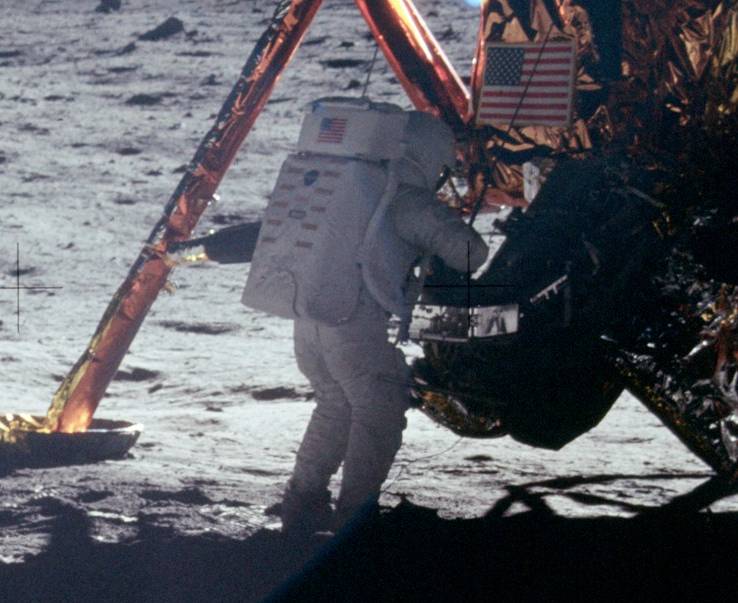 About 19 minutes after Armstrong's first step, Aldrin joined him on the surface, becoming the second human to walk on the Moon. They began their tasks of investigating how easily a person could operate on the lunar surface. Armstrong unveiled a plaque commemorating the flight, and with Aldrin, planted the flag of the United States. Although Armstrong had wanted the flag to be draped on the flagpole, it was decided to use a metal rod to hold it horizontally. However, the rod did not fully extend, leaving the flag with a slightly wavy appearance, as if there were a breeze. Shortly after the flag planting, President Richard Nixon spoke to them by telephone from his office. He spoke for about a minute, after which Armstrong responded for about thirty seconds. In the Apollo 11 photographic record, there are only five images of Armstrong partly shown or reflected. The mission was planned to the minute, with the majority of photographic tasks performed by Armstrong with the single Hasselblad camera
After they re-entered the LM, the hatch was closed and sealed. While preparing for liftoff, Armstrong and Aldrin discovered that, in their bulky space suits, they had broken the ignition switch for the ascent engine; using part of a pen, they pushed in the circuit breaker to start the launch sequence.The Eagle then continued to its rendezvous in lunar orbit, where it docked with Columbia, the command and service module. The three astronauts returned to Earth and splashed down in the Pacific Ocean, to be picked up by the USS Hornet.
Life after Apollo
 Shortly after Apollo 11, Armstrong announced that he did not plan to fly in space again. He was appointed Deputy Associate Administrator for Aeronautics for the Office of Advanced Research and Technology at ARPA, served in the position for a year, then resigned from it and NASA in 1971. He accepted a teaching position in the Department of Aerospace Engineering at the University of Cincinnati, having chosen Cincinnati over other universities, including his alma mater Purdue, because Cincinnati had a small aerospace department, and said he hoped the faculty there would not be annoyed that he came straight into a professorship with only a USC master's degree. He began his master's degree while stationed at Edwards years before, and completed it after Apollo 11 by presenting a report on various aspects of Apollo, instead of a thesis on the simulation of hypersonic flight.
At Cincinnati, Armstrong was University Professor of Aerospace Engineering. He took a heavy teaching load, taught core classes, and created two graduate-level classes: aircraft design and experimental flight mechanics. He was considered a good teacher, and a tough grader. His research activities during this time did not involve his work at NASA, as he did not want to give the appearance of favoritism; he later regretted the decision. After teaching for eight years, Armstrong resigned in 1980. When the university changed from an independent municipal university to a state school, bureaucracy increased. He did not want to be a part of the faculty collective bargaining group, so he decided to teach half-time. According to Armstrong, he had the same amount of work but received half his salary. In 1979, less than 10% of his income came from his university salary. Employees at the university did not know why he left.
Death
Armstrong underwent bypass surgery on August 7, 2012, to relieve coronary artery disease. Although he was reportedly recovering well, he developed complications in the hospital and died on August 25, in Cincinnati, Ohio, aged 82.